
Back On Air
Still in Saigon - Teaching Experience

That was quite a long break in my writing, and there were several reasons for that. The main reason is my more or less regular job teaching English at public schools. I don’t get all that many teaching hours, and it is not exactly an official job, but it allowed me to “stabilize” my situation here in a certain way. Now I don’t rely on spontaneous gigs and can finally be sure I can pay my rent next month. So, this is a change for good.
Teaching English at public schools is not exactly my dream job, but I still enjoy it. It’s not just the feeling of doing something useful and maybe changing these kids' lives for the better. It is also a unique opportunity to talk to them and find out what interests them, what they dream of, and their ideas of how things should be. That is a great experience you’ll never get as a tourist. And, I must say, I am surprised by how similar we are sometimes despite all the differences. Anyhow, with all that experience, I can now tell a little about Vietnamese schools.
The schools I teach at are located throughout Saigon. Modern schools usually look somewhat like a prison: a large square or a U-shaped building with classrooms along the perimeter, open hallways, and a big space in the middle which, depending on the needs, may serve as a gym, a canteen, or a place for different events.
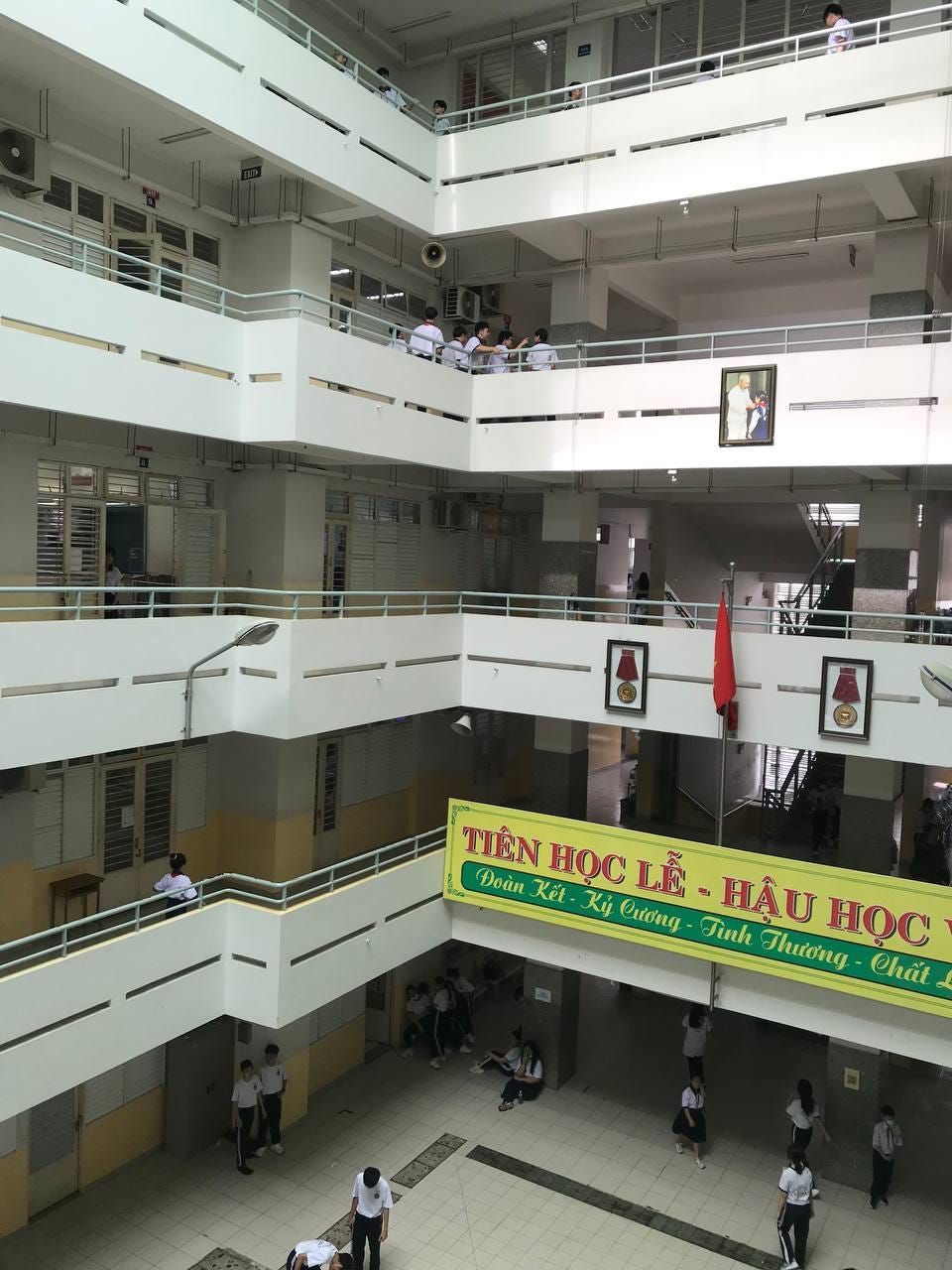
Some old school buildings, especially in Districts 1 and 3, date back to French colonial times and are quite impressive, although the buildings are designed according to the same principle. Below are some pictures from Le Quy Don High School, founded in 1874.


Public schools are usually separated: there are separate primary, secondary, and high schools, although sometimes a secondary school and a high school are in the same building. The classes are usually quite big, with at least 40 students in each class. Classes are also divided based on students’ performance and have numbers, like 8A9 or 11A2. I am not quite sure yet regarding how this system works, but in general, a class with an index of 1 or 2 (as in 10C2) would know English better than a class with an index of 8 or 9 (as in 10C9).
Wearing a uniform in Vietnamese public schools is mandatory, but uniforms may have some differences between schools (unlike in the Soviet Union, where school uniforms were the same throughout the country). A uniform includes a white shirt, navy blue pants for boys, a navy blue or checkered skirt for girls, and a tie. There is also a physical education uniform, including a T-shirt and long sports pants. As schools here don’t have changing rooms, students just come to school wearing their PE uniforms if they have a PE class on that day. Both uniform versions have patches on the left side just above a shirt pocket with the school name, class number, and student’s name.
Students here may be somewhat noisy and are sometimes too active, but they are just being kids. Understandably, they have more interesting things to do besides grammar exercises and writing tasks. However, class management is more of an issue in grades 6 to 8 as compared to high school. High school students, when they are not quite interested, would just quietly do their geometry homework or read something without distracting anyone. So, at a secondary school, I also have a Teacher Assistant (TA), usually a Vietnamese college student majoring in linguistics or similar. TAs help me manage a class and also explain something to students when they cannot understand an explanation in English.
Besides teaching, I do translation projects if there are any. It is still my preferred job - I like the setting of having a task and a deadline rather than an obligation to be at a certain place at a certain time. But there are not enough translation projects lately to make a living. I hope it will change, and I am also working on it, but teaching English at public schools here is still an experience I appreciate.